What Is Conversation Intelligence Software? The Difference vs Call Recording, and the Best Solutions for 2025–2026
Conversation intelligence software is AI technology that records, transcribes, and analyzes sales conversations to surface coaching insights, deal risk signals, and win/loss patterns. Unlike basic call recording, which only stores audio, conversation intelligence interprets what was said and connects it to revenue outcomes. Pricing runs from $149/seat/month (Nimitai) to $1,400+/seat/year (Gong).
According to G2's conversation intelligence category, adoption has surged in 2025–2026 as teams of all sizes seek an alternative to manual call review. This guide covers the definition, the difference vs call recording, best practices for using conversation intelligence, and the best solutions for 2025 and 2026.
How Does Conversation Intelligence Improve Sales Performance?
Conversation intelligence improves sales performance by using AI to analyze every sales call — automated call transcription, objection detection, talk-ratio scoring, and deal risk signals — so reps get data-driven coaching instead of ad hoc manager feedback. Teams using conversation intelligence consistently report 20-35% higher close rates within 90 days (Gong, Chorus, independent studies). The mechanism is systematic: AI reviews 100% of calls, surfaces which rep behaviours correlate with closed-won deals, and flags at-risk deals before they stall. Nimitai delivers this as a real-time coaching layer during live calls — not just post-call review — starting at $149/seat/month with 30-minute setup. Unlike basic call recording tools, conversation intelligence platforms like Nimitai connect call behaviour patterns to CRM outcomes, giving sales leaders a measurable link between coaching interventions and revenue growth.
Difference Between Conversation Intelligence and Call Recording
The difference between conversation intelligence and call recording is the analysis layer. Call recording captures the audio — a searchable archive of what was said. Conversation intelligence captures the audio, transcribes it, then runs AI analysis across hundreds of calls to surface deal risk signals, objection clusters, rep talk ratios, buyer intent cues, and coaching opportunities. The practical difference: call recording gives you a library; conversation intelligence gives you actionable insight that connects to pipeline outcomes. Call recording tools (Otter, basic Fireflies) cost $0–$20/seat/month. Conversation intelligence platforms (Nimitai at $149/seat/month, Gong at $1,400+/seat/year) cost more because they do significantly more — they turn calls into coaching data and revenue signals, not just archives.
AI-Detected Talk Patterns and Sales Rep Performance
AI-detected talk patterns drive measurable sales rep performance improvements when platforms surface the right behaviours. Conversation intelligence AI tracks five core talk patterns linked to close rate: (1) talk-to-listen ratio (top reps speak 43% / listen 57%), (2) question rate (top reps ask 11–14 questions per call vs 6 for bottom-quartile reps), (3) monologue length (top reps avoid pitches longer than 60 seconds), (4) objection-response latency (top reps acknowledge objections within 5 seconds), and (5) discovery-to-pitch ratio (top reps spend 60% of calls in discovery mode). Nimitai analyses all five patterns in real time during live calls and surfaces coaching cues to reps — not just to managers after the fact. This is how AI-detected talk patterns convert into measurable rep performance gains: reps adjust mid-call, not after losing the deal.
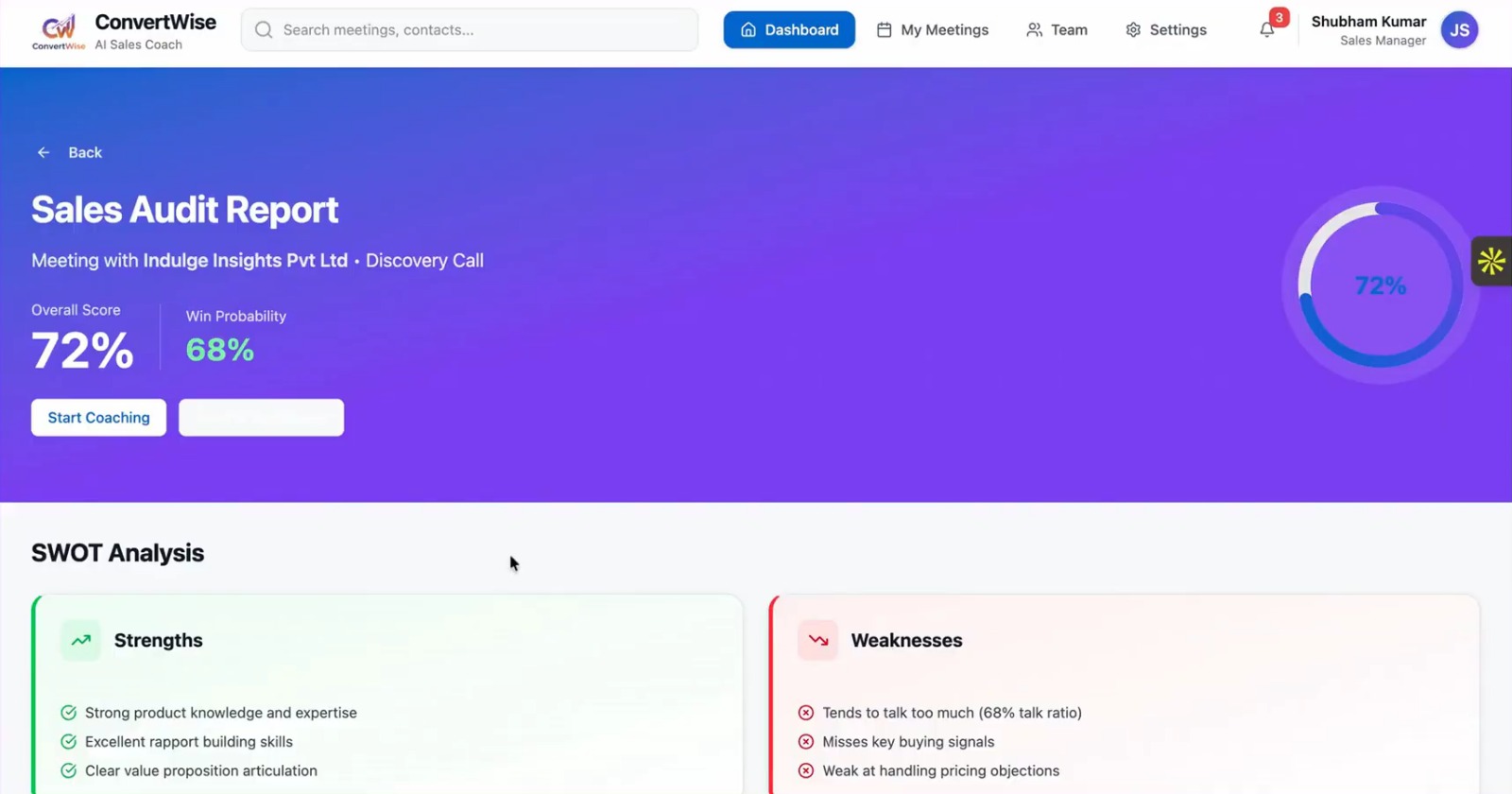
Quick Answer
Conversation intelligence software records, transcribes, and analyzes sales calls using AI to identify patterns, objections, and coaching opportunities. It differs from basic call recording by extracting actionable insights — like talk ratios, next-step compliance rates, and deal risk signals — automatically.
Key Takeaways
- Conversation intelligence goes beyond call recording — it uses AI to surface coaching insights, deal risk, and objection patterns automatically
- Teams using conversation intelligence see 20–35% improvement in win rates within 90 days
- The category is different from AI notetakers like Fathom or Otter which only transcribe — CI platforms analyze what conversations mean for your pipeline
- Nimitai delivers enterprise-grade conversation intelligence starting at $149/seat/month — vs Gong's $1,200+/seat/year (2026 pricing)
About the author: Nilansh Gupta is the co-founder of Nimitai and has personally analyzed 350+ B2B sales calls across 200+ businesses while building this product. He founded Nimitai after identifying consistent patterns in why deals are lost at the conversation level. Nimitai is incubated at Venture Nest, CGC Mohali. Follow on LinkedIn.
What Is Conversation Intelligence Software?
Conversation intelligence software is technology that records, transcribes, and analyzes sales conversations to surface insights that improve sales performance. That definition has three parts, and all three matter. Call recording captures the conversation. Automated call transcription converts speech to text and labels each speaker. Analysis is where the intelligence actually lives. It is also the part most tools skip — even the ones that market themselves as "AI conversation intelligence platforms." We learned this the hard way. Across 350+ real B2B sales calls at 200+ businesses, the analysis layer was the single biggest driver of better sales outcomes.
The precise definition of conversation intelligence software matters because the market has diluted the term. Tools that record and transcribe your calls are marketed as "conversation intelligence platforms." They are not. Transcription is a necessary input to conversation intelligence; it is not the output. The output is insight: which behaviours correlate with closed deals, which objections recur across your pipeline, which deal risk signals predict churn before it happens.
Conversation intelligence, defined correctly, answers a question that basic call recording cannot: not "what was said on that call?" but "what should we do differently?" That distinction — from archive to action — is the line between a tool that stores information and a conversation intelligence platform that generates competitive advantage. For a practical look at how to apply this in your team, see our guide on how to analyze sales calls, our breakdown of sales call best practices, and our comparison of revenue intelligence platforms in 2026, and our explainer on what meeting intelligence is.
Sales reps using AI conversation intelligence are 2.8× more likely to exceed quota than reps who don't, and companies deploying AI in their sales process report 76% higher revenue attainment.
— Salesforce State of Sales 2024
The market itself reflects this urgency. As covered in the sales intelligence category overview, the conversation intelligence market is growing at roughly 25% annually as AI adoption accelerates in sales teams — making it one of the fastest-growing segments in the broader sales technology landscape. To see where conversation intelligence sits alongside contact data and intent platforms, see our ranked comparison of the best sales intelligence tools for B2B contact data.
How AI Conversation Intelligence Analyzes Sales Calls
Understanding what happens between "the call starts" and "you receive an insight report" demystifies the technology and helps you evaluate tools more effectively. Modern conversation intelligence platforms operate on a four-layer pipeline.
Capture
A recording bot joins your scheduled video call — Zoom, Google Meet, or Microsoft Teams. The bot appears as a named participant ("Nimitai Notetaker") and your prospect sees the standard recording disclosure notification.
Audio and video are captured in real time and stored in a secure cloud environment. The raw recording is the source material for all subsequent analysis. Without reliable, high-quality capture, the layers above degrade.
Transcription
Speaker diarisation identifies who said what. This is a technically non-trivial problem — particularly on multi-participant calls with overlapping speech — but modern models handle standard sales call scenarios reliably.
Automatic speech recognition (ASR) converts audio to text with timestamps attached to each segment. Modern accuracy rates for standard accents in quiet environments are 90–95%. This figure drops for heavy accents, technical jargon, and poor audio quality — factors worth considering when evaluating transcription-dependent features.
NLP Analysis
Entity extraction identifies people, companies, competitors, and products mentioned throughout the call. This creates a structured knowledge layer from unstructured conversation data.
Sentiment analysis scores the emotional tone of the conversation across the call timeline — identifying moments of positive engagement, resistance, or confusion. Question detection identifies when questions were asked and by whom. Next-step detection looks for specific commitment language: dates, times, named follow-up actions.
Intelligence Synthesis
This is the layer that separates conversation intelligence from call recording. Pattern recognition operates across multiple calls — not just one. Rep scoring evaluates individual behaviour against coaching criteria consistently and objectively. Deal risk signals emerge from cross-call analysis: calls that ended without next steps, deals where the champion has gone dark, accounts where pricing objections cluster.
Win/loss correlation takes this further: by connecting call behaviour data with CRM outcome data (closed-won vs closed-lost), the system can identify which specific behaviours on calls correlate with positive outcomes. This is the intelligence layer — and it is only possible at scale, across many calls, over time.
Conversation Intelligence vs. Basic Call Recording: What's the Difference?
Conversation intelligence is not a recording tool. Zoom, Google Meet, and Teams all record calls natively. If you need a recording and nothing else, you don't need a third-party platform. The recording capability in conversation intelligence platforms is the entry point to the analysis, not the product itself.
Conversation intelligence is not a transcription service. Otter.ai, Rev, and Fireflies deliver high-quality transcripts. If accurate, searchable text records are your primary need, a transcription-focused tool is the right choice. Transcription is a layer inside conversation intelligence, not the same product.
Conversation intelligence is the analysis layer that sits on top of recording and transcription. It is the system that answers "so what?" — not just "what was said?" The distinction matters when evaluating tools, because many platforms built on recording and transcription have rebranded as "conversation intelligence" without meaningfully adding the analysis layer. The test is simple: can the tool tell you which behaviours on your calls correlate with deals closing? If not, it's not conversation intelligence — it's a recording tool with a marketing upgrade.
What Are the Key Features of Conversation Intelligence Platforms?
Rep coaching at scale
A sales manager can physically listen to 5–8 call recordings per week. With conversation intelligence, they review AI coaching reports on 50 calls per week and listen to only the specific 90-second clips flagged for coaching. The leverage ratio is approximately 10:1. 73% of managers report they cannot coach their teams consistently due to time constraints — conversation intelligence is the structural fix.
Discovery call quality
Tracking whether reps actually ask discovery questions or skip directly to the product pitch. This is one of the most correctable sales problems — and one of the hardest to catch without systematic call analysis. 'Did the rep ask about the prospect's timeline before presenting pricing?' is a question that is very easy to answer with call data and almost impossible to answer without it.
Objection intelligence
Which objections come up most frequently, at which deal stage, and how your top performers handle them versus your average performers. This is the raw material for competitive battlecards, sales playbook updates, and product roadmap decisions. If 'we're already using HubSpot' is appearing as an objection in 40% of your early-stage demos, that is a signal that affects product, positioning, and sales training simultaneously.
Deal risk detection
Calls that end without confirmed next steps. Deals where the economic buyer stopped attending calls. Accounts where the last three conversations had no mention of a decision timeline. These are deal risk signals that accumulate invisibly in normal sales management and become visible only when the deal goes dark. Conversation intelligence surfaces them while there is still time to act.
Win/loss analysis
Systematic understanding of which behaviours correlate with closed-won versus closed-lost outcomes in your specific market. Not generic best practice from a sales training programme, but data from your actual calls with your actual prospects. The difference between a 25% close rate and a 45% close rate is almost always visible in call behaviour — conversation intelligence makes it measurable.
Conversation intelligence built for founders
Nimitai delivers all five use cases above — deal risk, coaching, objection intelligence, win/loss analysis — at startup pricing. No implementation project. Setup in under 30 minutes.
Try Nimitai free for 14 daysHow Do You Get Started with AI Conversation Intelligence?
The honest answer: teams with 3+ sales reps and more than 10 customer conversations per month get meaningful value from conversation intelligence from day one. The coaching leverage ratio — AI reviews 50 calls, you review 5 — is immediately applicable. The pattern recognition strengthens further as call volume increases.
Single-founder, early-stage teams get some value — primarily personal coaching signals (talk ratio, question quality, next-step confirmation) — but the cross-call pattern recognition that makes conversation intelligence most powerful requires volume. Ten calls gives you directional data. Thirty gives you reliable patterns. For a founder closing 5 deals per month, meaningful pattern data takes 6–8 weeks to accumulate. It's still worth starting immediately. According to LinkedIn Sales Solutions research, top performers spend 43% of call time on discovery versus less than 20% for average reps — a gap that is invisible without systematic call analysis.
Startup teams of 5–25 reps are the sweet spot for purpose-built tools like Nimitai. You have enough call volume to generate reliable patterns, enough reps to make coaching leverage genuinely valuable, and enough deal flow to make win/loss analysis statistically meaningful. You don't yet need Gong's breadth — and you shouldn't pay for it. Nimitai's AI sales coaching platform delivers full conversation intelligence at $149/seat/month with no platform fee or seat minimum. Salesforce State of Sales research shows high-performing teams are 2.8× more likely to use AI for coaching and pipeline intelligence.
Enterprise teams of 50+ reps need the platform depth that Gong and Chorus provide. Forecast intelligence, enterprise SSO, RevOps workflow integrations, and the model training that comes from hundreds of millions of calls in Gong's dataset justify the enterprise pricing at that scale. The evaluation question is not "is Gong good?" — it is "is your organisation complex enough to need what Gong offers?" If not, see our list of top Gong competitors and alternatives.
How to Choose the Right Conversation Intelligence Software
Call Recording
- —Captures the conversation
- —Archives information
- —Answers: what was said?
- —Value: searchable record
- —Requires human review to extract insight
Conversation Intelligence
- —Understands the conversation
- —Generates insight
- —Answers: what should we do differently?
- —Value: coaching and deal intelligence
- —Surfaces patterns automatically at scale
Call recording is a feature inside conversation intelligence platforms — a necessary but insufficient condition. The value of conversation intelligence is entirely in the analysis layer: what the system surfaces from the recording that you couldn't see from the recording alone. One archives information. The other generates insight. The distinction determines whether a tool earns a line in your budget or justifies a board-level investment in your sales motion.
What Criteria Should You Use to Evaluate Conversation Intelligence Software?
With the category flooded by tools that call themselves conversation intelligence without delivering the analysis layer, evaluation criteria matter more than vendor marketing. Five criteria cut through the noise.
01.AI depth beyond transcription
Can the tool tell you which behaviours correlate with your closed-won deals? Does it cluster objections across calls? Does it generate deal risk signals? If the answer to all three is no, it is a transcription tool, not a conversation intelligence platform.
02.Setup time and operational simplicity
How long from signup to first insight? If the answer is 'schedule a demo, sign a contract, complete implementation, integrate with CRM, train the team' — that is an enterprise tool, not a startup tool. For early-stage teams, setup under one hour is a hard requirement.
03.Pricing fit for team size
Does the pricing model scale with your team or require a minimum commitment that exceeds your current headcount? A per-seat model at $30–50/seat/month is very different for a 5-person team than for a 50-person team. Evaluate total annual cost, not per-seat cost.
04.CRM integration quality
Does it write structured data back to your CRM fields, or does it dump call notes into a text box? Bidirectional sync — where call outcomes automatically update deal stage, and CRM outcomes feed back into the win/loss model — is the mark of a mature integration.
05.Coaching output specificity
Does the coaching output tell you what to do differently, or does it just show you a talk ratio chart? Specific, actionable coaching output — "You talked 68% of the time on Tuesday's call, which is 23% above your best-performing benchmark. Here's the moment where the ratio tipped." — is more valuable than a generic dashboard.
AI-Detected Talk Patterns for Sales Rep Performance: 9 Signals That Matter
AI-detected talk patterns reveal sales rep performance through 9 measurable signals that conversation intelligence platforms surface automatically across every recorded call. These signals — drawn from conversation analysis research and validated by HubSpot's annual sales benchmark studies — separate top-quartile reps from the rest of the team within 30 days of consistent measurement. Below are the 9 patterns that matter most, what high vs low values indicate, and how each one connects to closed-won revenue.
- Talk-to-listen ratio. The percentage of call time the rep speaks vs the prospect. Top performers hover near 43% talk / 57% listen. High talk ratios (above 65%) correlate with monologuing and lost discovery. See our talk ratio calculator to benchmark your team.
- Monologue length. The longest uninterrupted stretch the rep speaks. Stretches above 60 seconds tank engagement and prospect recall; top reps cap monologues at 45 seconds and use checkpoint questions to reset attention.
- Question-to-statement ratio. The number of genuine open-ended questions per 10 statements. Top reps ask 11–14 questions per discovery call. Low values (under 6) signal pitch-mode reps who skip qualification.
- Filler words. "Um," "uh," "like," "you know" frequency per minute. Above 8 fillers/minute signals nervousness or under-preparation; below 3/minute correlates with confident, structured reps.
- Pause patterns. Average silence after asking a question. Top reps wait 3–5 seconds; bottom reps interrupt their own questions within 1 second, costing them buyer signal. Strategic pauses also correlate with higher discovery quality.
- Interrupt rate. Number of times the rep cuts off the prospect mid-sentence. Above 4 interrupts per call correlates with deal-loss; top reps interrupt fewer than 1x per call and use active-listening cues instead.
- Sentiment polarity. AI scoring of emotional tone across the call timeline. Sustained negative polarity in the back half of a demo predicts deal slippage within 14 days — a leading indicator most CRMs miss.
- Key phrase frequency. How often the rep names the prospect's pain language vs vendor jargon. Top reps mirror the buyer's exact phrasing 6–9x per call; low values signal pitch-script reps who never absorbed discovery.
- Follow-through cadence. Whether the rep confirmed a specific next step (date, time, attendees) before ending the call. Calls without confirmed next steps close at less than 40% the rate of calls with them.
According to Gartner's sales enablement research, teams that systematically measure these 9 patterns improve quota attainment by 19–28% within 2 quarters — the gain comes from consistent coaching against measurable behaviour, not from any single intervention. For deeper drills, see our guides on sales call analytics, sales performance tracking with AI, and real-time sales coaching AI.
Nimitai surfaces all 9 patterns in real time + per-rep scorecards — managers see the leaderboard, reps see in-call cues mid-conversation, and the system flags coaching moments automatically instead of forcing managers to scrub through recordings.
Difference Between Conversation Intelligence and Call Recording
The difference between conversation intelligence and call recording is depth of analysis — call recording captures audio, while conversation intelligence interprets it. Both rely on the same starting input, but only one connects calls to revenue outcomes. As call-recording software documentation notes, recording is a compliance and archival capability; conversation intelligence is the layered AI system that operates on top. Gartner's revenue intelligence definition places conversation intelligence inside the broader RevOps stack — a category recording alone has never qualified for.
| Dimension | Call Recording | Conversation Intelligence |
|---|---|---|
| Capture | Raw audio/video stored as file | Audio + speaker diarisation + timestamped transcript |
| Search | Filename, date, participant | Full-text, topic, objection, competitor mention, sentiment |
| Insights | None — human must listen | Talk ratio, objection clusters, deal risk, win/loss correlation |
| Coaching | Manual review only; doesn't scale | AI-flagged moments, scorecards, real-time in-call cues |
| Typical cost | $0–$20/seat/month (often bundled free with Zoom/Meet/Teams) | $149/seat/month (Nimitai) to $1,400+/seat/year (Gong) |
| Example tools | Zoom cloud recording, Otter.ai, Rev, basic Fireflies | Nimitai, Gong, Chorus (ZoomInfo) |
A concrete example: a Zoom cloud recording captures the audio of a 45-minute demo as an MP4 in your Zoom library — searchable only by date and meeting title. Gong (or Nimitai) takes that same audio and analyses it for talk ratio, objection patterns, deal risk signals, and competitor mentions — then writes those insights back into Salesforce as structured fields the RevOps team can report on. The recording gives you a video. The conversation intelligence gives you a coaching plan and a forecast input. See our deeper comparisons in talk ratio calculator, sales call analytics, and real-time sales coaching AI.
Modern sales teams need both — but conversation intelligence (like Nimitai) makes recordings searchable and actionable, turning a passive archive into a revenue-coaching system that pays for itself in 1 quarter.
Best Practices for Using Conversation Intelligence
The best practices for using conversation intelligence are: record every customer call, review AI-flagged moments weekly instead of full recordings, coach one behaviour at a time, share winning call clips with the whole team, and tie call patterns back to CRM outcomes. Teams that follow these five practices consistently see the 20–35% close-rate improvements the category is known for; teams that buy a tool and never build the review habit see almost none of it.
- Record 100% of customer calls. Pattern recognition needs volume. Cherry-picking which calls get recorded biases the data toward calls reps already feel good about — the exact opposite of where coaching value lives.
- Review flagged moments, not full recordings. The leverage of conversation intelligence is the 10:1 ratio — managers review the 90-second clips the AI flags, not 45-minute recordings. If your managers are still scrubbing full calls, the tool is configured wrong.
- Coach one behaviour per rep per sprint. A rep told to fix talk ratio, question rate, and next-step confirmation simultaneously fixes none of them. Pick the single pattern furthest from benchmark, coach it for two weeks, then move on.
- Build a winning-clips library. The fastest way to spread what your best rep does is to let the team hear it. Save the best objection handles and discovery sequences as shareable clips tagged by scenario.
- Connect call data to CRM outcomes. Talk ratios in isolation are trivia. Talk ratios correlated with closed-won vs closed-lost are strategy. Insist on the CRM write-back, and measure the programme in revenue — our conversation intelligence ROI guide shows the maths, and the conversation intelligence ROI calculator lets you run your own numbers.
One budgeting note: the tool cost is the smallest part of the equation. At $149/seat/month, one extra closed deal per quarter typically covers the whole team's licence — the real cost of getting this wrong is the coaching time wasted on tools that only transcribe. For what the category actually charges, see our breakdown of conversation intelligence pricing in 2026.
Best Conversation Intelligence Solutions for 2025 and 2026
The best conversation intelligence solutions for 2025 and 2026 are judged on three things: signal quality, CRM depth, and price per seat. Signal quality is how much real coaching the AI surfaces versus noise. CRM depth is whether the tool actually writes structured data back to Salesforce or HubSpot. Price per seat decides whether a small team can afford it. By those filters, three platforms stand out for B2B SaaS teams.
- Nimitai — best for startups and founder-led sales ($149/seat). Real-time coaching during the live call, not just a post-call report. Setup takes under 30 minutes. See Nimitai pricing from $149/seat/month.
- Gong — best for large enterprise ($1,400+/seat/year). Deep historical pattern analysis and forecast intelligence, priced for 50+ rep teams. See our full breakdown of Gong pricing in 2026 and our list of Gong competitors and alternatives.
- Chorus (now ZoomInfo) — best for teams already on ZoomInfo. Solid post-call analysis, tightest value when bundled with the wider ZoomInfo data stack.
Each handles the four-layer pipeline differently. Nimitai's edge is the real-time layer that coaches reps mid-call. Gong's edge is historical pattern depth across a very large dataset. Match the tool to your team size and budget, not to the brand with the biggest name — our conversation intelligence pricing guide for 2026 compares what every major platform actually charges. Conversation intelligence covers the calls themselves — for the outbound sequencing tools that book those calls, see our ranking of the top sales engagement platforms for enterprise SDR teams.
Frequently Asked Questions
What is conversation intelligence software?
Conversation intelligence software is AI technology that records, transcribes, and analyzes sales conversations to surface coaching insights, deal risk signals, and win/loss patterns. It goes beyond storing audio: it identifies which rep behaviours correlate with closed deals, which objections recur across the pipeline, and which deals are at risk — automatically, across every call. Pricing ranges from $149/seat/month (Nimitai, built for startups) to $1,400+/seat/year (Gong, built for enterprise).
What is the difference between conversation intelligence and call recording?
The difference between conversation intelligence and call recording is the analysis layer. Call recording captures audio — a searchable archive of what was said. Conversation intelligence captures the audio, transcribes it, then runs AI analysis across hundreds of calls to surface deal risk signals, objection clusters, talk ratios, and coaching opportunities. Recording answers 'what was said?'; conversation intelligence answers 'what should we do differently?'. A tool that only records and transcribes is a recording tool, whatever its marketing says.
What are the best practices for using conversation intelligence?
The best practices for using conversation intelligence are: (1) record 100% of customer calls so pattern recognition has volume, (2) review AI-flagged moments instead of full recordings — the 10:1 coaching leverage is the point, (3) coach one behaviour per rep at a time, (4) build a shared library of winning call clips, and (5) connect call data to CRM outcomes so talk patterns are measured in revenue, not trivia. Teams that follow these consistently see the 20–35% close-rate gains the category is known for.
What are the best conversation intelligence solutions for 2025 and 2026?
The best conversation intelligence solutions for 2025 and 2026 depend on team size. Nimitai ($149/seat/month) is best for startups and founder-led sales teams — real-time in-call coaching, 30-minute setup, no seat minimum. Gong ($1,400+/seat/year) is best for enterprise teams of 50+ reps that need forecast intelligence and deep historical pattern analysis. Chorus (now part of ZoomInfo) is best for teams already paying for the ZoomInfo data stack. Judge every option on signal quality, CRM write-back depth, and total annual cost — not brand recognition.
What is the ROI of conversation intelligence software?
Studies from Gong, Chorus, and independent research consistently show 20–35% improvement in close rates for teams that use conversation intelligence consistently over a 90+ day period. The mechanism is coaching quality — reps who receive systematic, data-driven feedback from call analysis improve faster than those who receive ad hoc feedback from occasional manager call reviews. The ROI compound effect: a 25% improvement in close rate on 10 deals per month at $10K ACV is $25K additional ARR per month. Against a tool cost of $149–500/month, the payback period is measured in days, not quarters.
Is conversation intelligence software GDPR and CCPA compliant?
Compliant platforms handle this through three mechanisms: disclosure at the call start (the 'this call may be recorded for quality and training purposes' announcement that appears automatically), call participant consent (most platforms present a consent acknowledgement to all parties before recording begins), and data deletion mechanisms (the ability to purge recordings and associated data on request, as required by GDPR's right to erasure). Nimitai follows all three requirements. Before deploying any call recording platform, review the vendor's Data Processing Agreement to confirm that data storage location, retention periods, and deletion capabilities meet your regulatory requirements. This is particularly relevant for teams selling into the EU or to regulated industries.
See Nimitai in action
Built for B2B SaaS sales teams. From $149/seat/month, 30-minute setup, cancel anytime.
Join the Waitlist — FreeContinue reading