The primary drivers of CI platform ROI are close rate improvement, deal size expansion, ramp time reduction, and coaching time savings. Understanding which drivers matter most for your team helps you model accurate ROI expectations and choose the right platform. Here is how each driver contributes.
Close rate improvement (largest driver)
Close rate improvement accounts for 60 to 70% of total CI ROI for most teams. The mechanism is straightforward: CI platforms surface the behaviors that separate top performers from average performers, then make those behaviors accessible to every rep through coaching, alerts, and pattern replication. Increasing close rate by even 3 to 5 percentage points on existing pipeline generates outsized revenue relative to platform cost. A structured win-loss analysis program is how most teams find those points. It isolates the behaviors that actually decide closed-won versus closed-lost.
Specific behaviors that drive close rate improvement include:
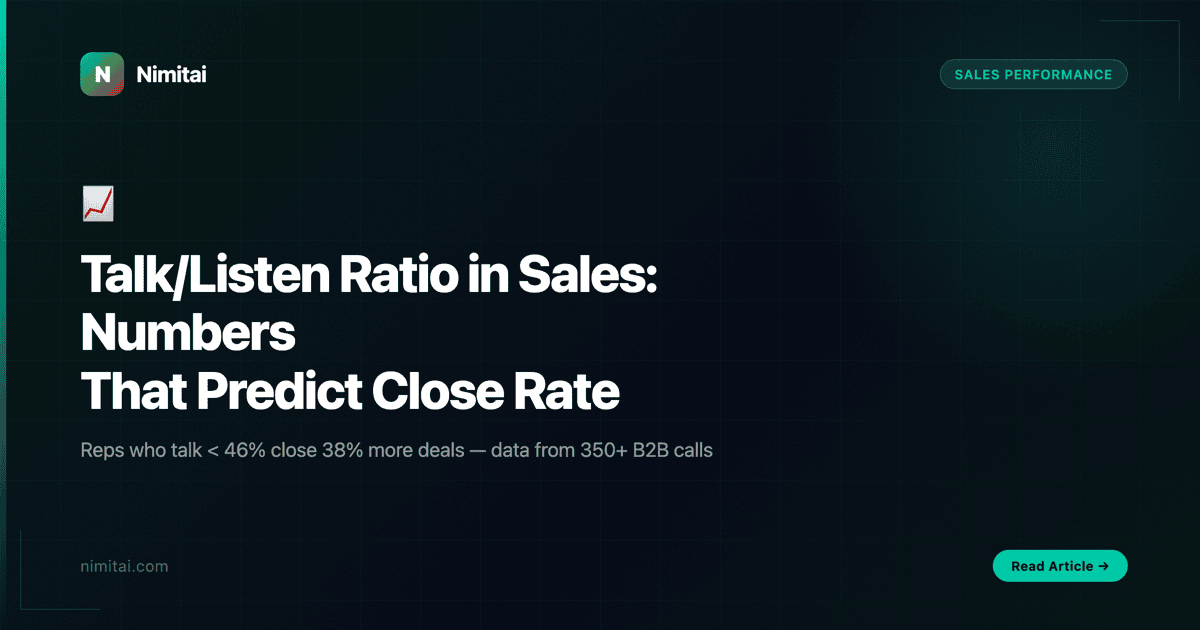
- Optimal talk-to-listen ratios: top performers maintain 40 to 45% talk time while average reps dominate at 60%+
- Signal responsiveness: responding to buying signals within the same conversation, not the follow-up
- Objection pre-emption: addressing common concerns before the prospect raises them
- Next-step discipline: booking the next meeting before the current call ends
New hire ramp time reduction
New reps typically take 6 to 9 months to reach full productivity. CI platforms reduce this to 3 to 5 months by giving new hires immediate access to winning call patterns, real-time coaching guidance, and automated feedback that would otherwise require months of trial-and-error learning. For a team hiring 5 reps per year at $150K OTE, cutting ramp time by 3 months saves approximately $187,500 in unproductive salary.
Manager coaching efficiency
Sales managers spend 5 to 8 hours per week reviewing calls and preparing coaching feedback. CI platforms automate 70 to 80% of this work, surfacing the moments that matter, scoring rep behaviors, and delivering specific coaching recommendations. Those recovered hours go directly into pipeline management, hiring, or strategic work.
Deal size expansion
Better discovery and objection handling naturally expands deal sizes because reps uncover more pain, involve more stakeholders, and articulate value more precisely. Teams using CI platforms consistently report 5 to 15% increases in average deal size, a secondary benefit that often surprises buyers who originally purchased for close rate improvement alone.
The compounding effect
CI ROI compounds over time. In month one, you establish baselines. By month three, behavioral changes appear. By month six, those behavioral changes are reinforced into permanent habits. By month twelve, your "new normal" close rate is the baseline for further improvement. This compounding is why second-year CI ROI often exceeds first-year ROI despite no additional investment.