Nimit AI
0%
Nimit AI
Get started
ProductResearcher AgentPreparation AgentMeeting CopilotPricing
SolutionsAI sales meeting prepAI meeting assistantAI sales coachingNimitai vs Gong
ResourcesFree sales toolsState of B2B Sales AI 2026BlogAbout the team
Get started →
Nimit AI
Get started
ProductResearcher AgentPreparation AgentMeeting CopilotPricing
SolutionsAI sales meeting prepAI meeting assistantAI sales coachingNimitai vs Gong
ResourcesFree sales toolsState of B2B Sales AI 2026BlogAbout the team
Get started →
Nimit AI
Get started
ProductResearcher AgentPreparation AgentMeeting CopilotPricing
SolutionsAI sales meeting prepAI meeting assistantAI sales coachingNimitai vs Gong
ResourcesFree sales toolsState of B2B Sales AI 2026BlogAbout the team
Get started →
HomeBlogFounder Playbook5 Lessons From Pitching to VCs at Innopreneurs Season 12
Back to all articles
Founder PlaybookApril 17, 2026•14 min read

5 Lessons From Pitching to VCs at Innopreneurs Season 12

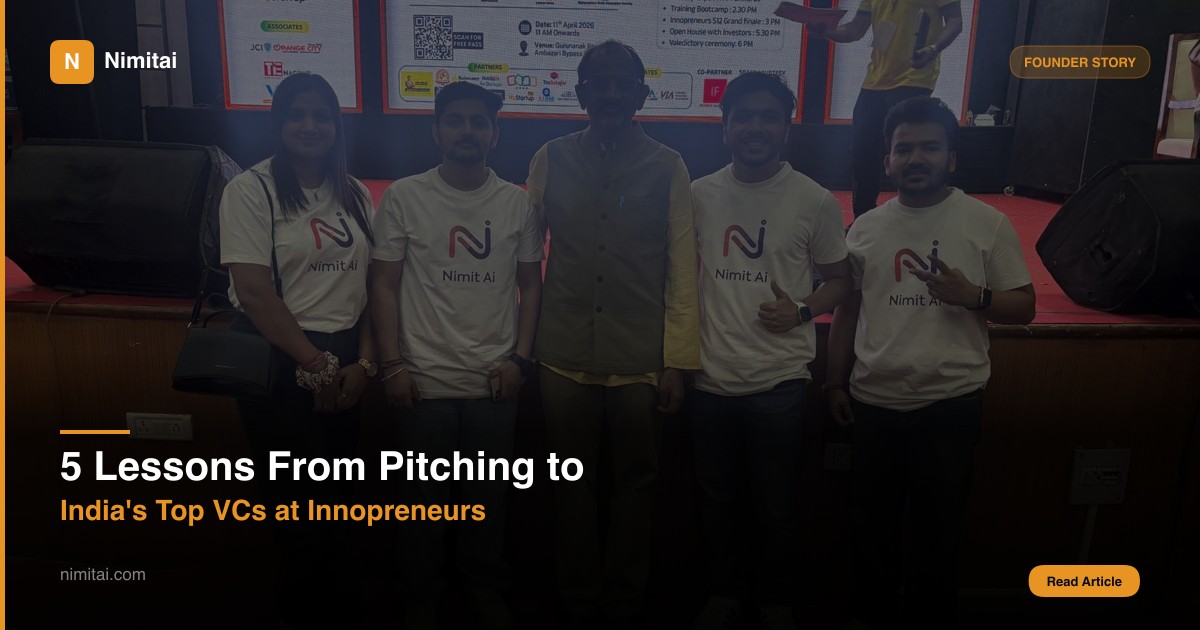
We pitched Nimitai live to 400+ people and a 5-judge panel at Innopreneurs Season 12, Nagpur. Here is what we learned from judges, investors, and mentors who pulled no punches.

Nilansh Gupta

Nilansh Gupta

Founder & CEO at Nimit AI

Share
Five pitch lessons from Innopreneurs Season 12 by Lemon Ideas, Nagpur: live demo, metrics, pivots, emotional pain, daily research
Nimitai team presenting on stage at Innopreneurs Season 12 by Lemon Ideas, Nagpur, pitching to a 400+ audience and 5 judges at the Viksit Bharat Conclave

The Nimitai team pitching on stage at Innopreneurs Season 12, Viksit Bharat Conclave, RTMNU Nagpur. All three of us presenting to 400+ people and a panel of 5 judges.

Quick answer
“The five most important lessons from pitching at Innopreneurs Season 12 (Lemon Ideas, Nagpur) are: run a live demo, know your metrics cold, treat pivoting as strategy, position around emotional pain not features, and do deep research every single day. These came directly from the five judges, including Dr. Vishesh Kasliwal (Medysense), Sagar Bhajani (Khichdiwala), Dr. Abhay Deshmukh (Incubation Foundation), and Akash Kirtane (Acube AI).”

The context

In April 2026, we pitched Nimitai at Innopreneurs Season 12, a national innovation programme organised by Lemon Ideas at Rashtrasant Tukadoji Maharaj Nagpur University (RTMNU). We were one of 10 startups selected from 2,500 applicants across India, a cohort that later received a letter of appreciation from Union Minister Nitin Gadkari.

The final pitch happened in a packed auditorium: 400+ people in the audience, five judges on the panel, and Amit Singal (Partner, Fluid Ventures) as head judge. The adrenaline was real. But more than the competition result, what stayed with us were the conversations with judges, investors, and mentors that forced us to rethink how we talk about Nimitai.

This post captures five lessons from that experience. They are specific, they come from real people, and they apply well beyond startup competitions. For the full personal story of how we got to Nagpur, including our first-ever flight and first-ever stage, read Shubham's account.

Lesson 1: Run a live demo, not just slides

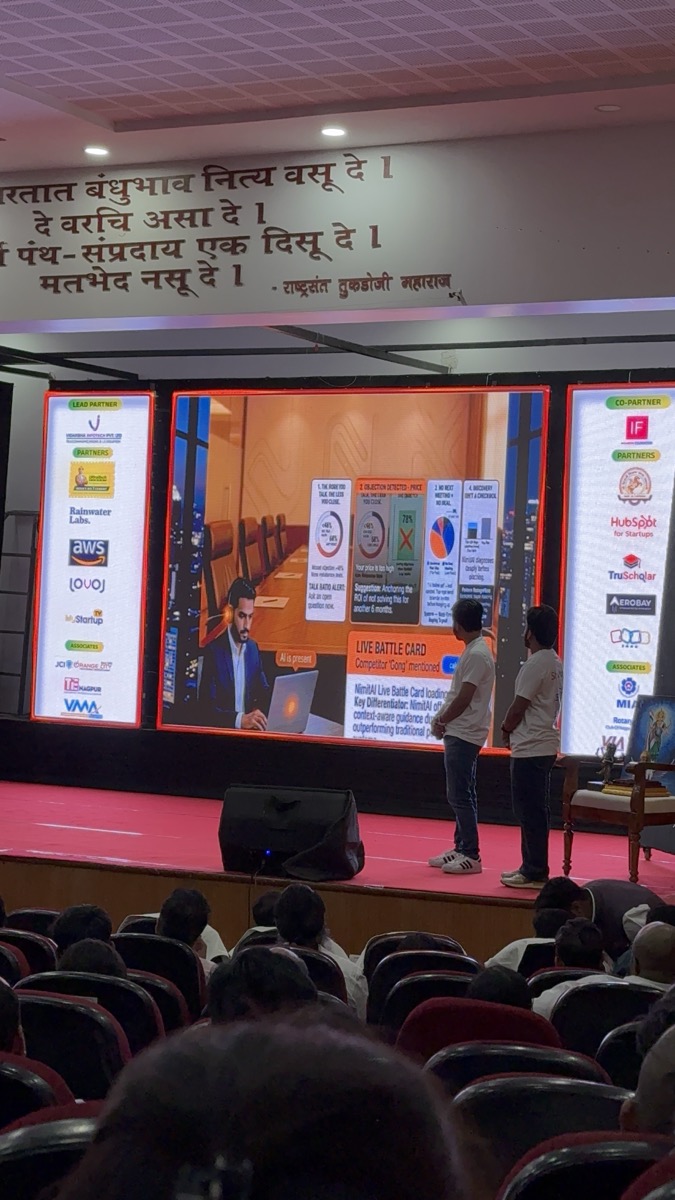
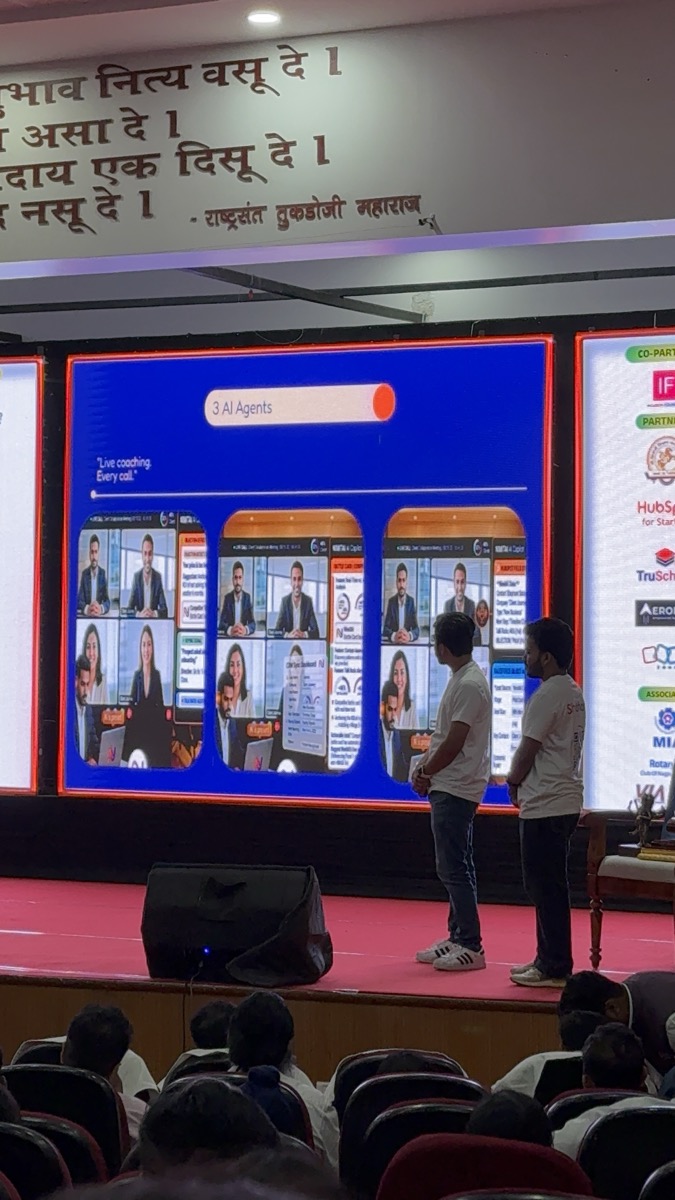
We made a decision early on: no product screenshots, no recorded walkthrough. We would demo Nimitai's AI agent live, in front of the entire room, while the pitch was happening.

It was risky. A live demo can go wrong in a dozen ways: connectivity issues, latency spikes, unexpected edge cases. We practised it many times. But the decision to go live changed the texture of every conversation we had after stepping off stage.

Slides tell investors what you plan to build. A live demo shows them you already built it, and that it works under pressure.

The practical difference

When you show a slide with a feature, investors form a hypothesis. When you demo it live, they form an opinion. Opinions lead to sharper questions, which lead to more useful feedback. The judges' follow-up questions after our demo were more specific and more useful than anything we anticipated preparing for.

The audience reaction during the live demo was noticeably different from what slides alone typically generate: people leaned forward, a few pulled out their phones to photograph the screen, and the post-pitch Q&A went several minutes over because the judges had more they wanted to understand.

Nimitai live AI agent demo during the pitch at Innopreneurs Season 12, Nagpur

The live Nimitai AI agent demo mid-pitch. Risky, but the reaction was completely different from slides.

Every surface is a demo opportunity

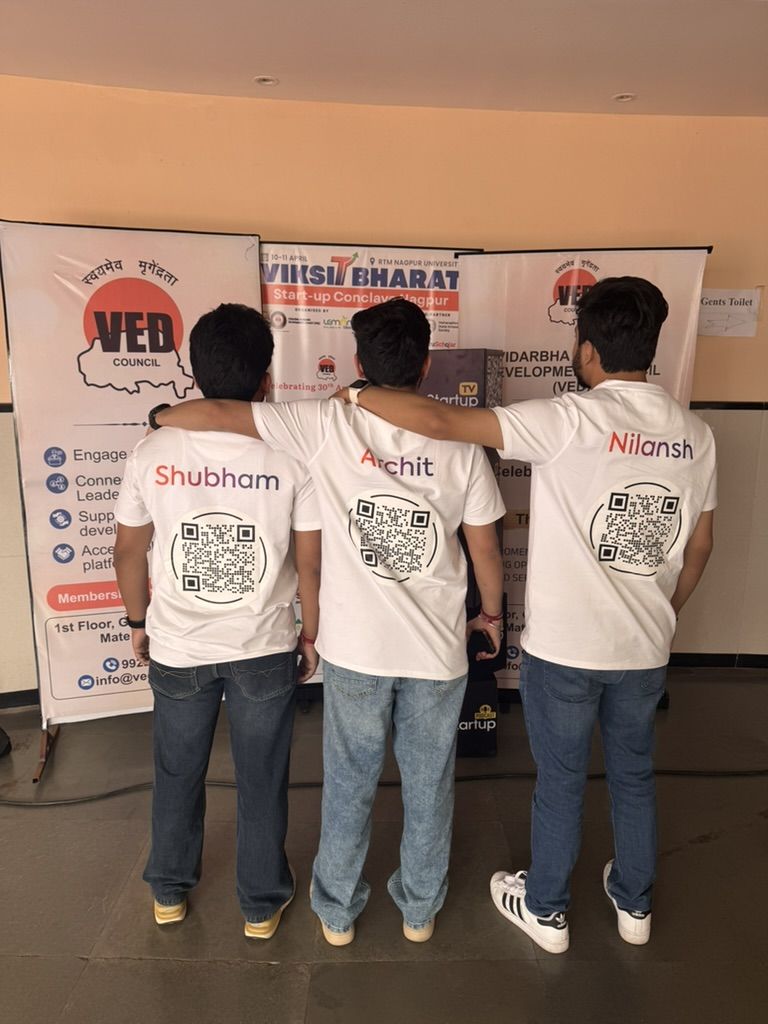
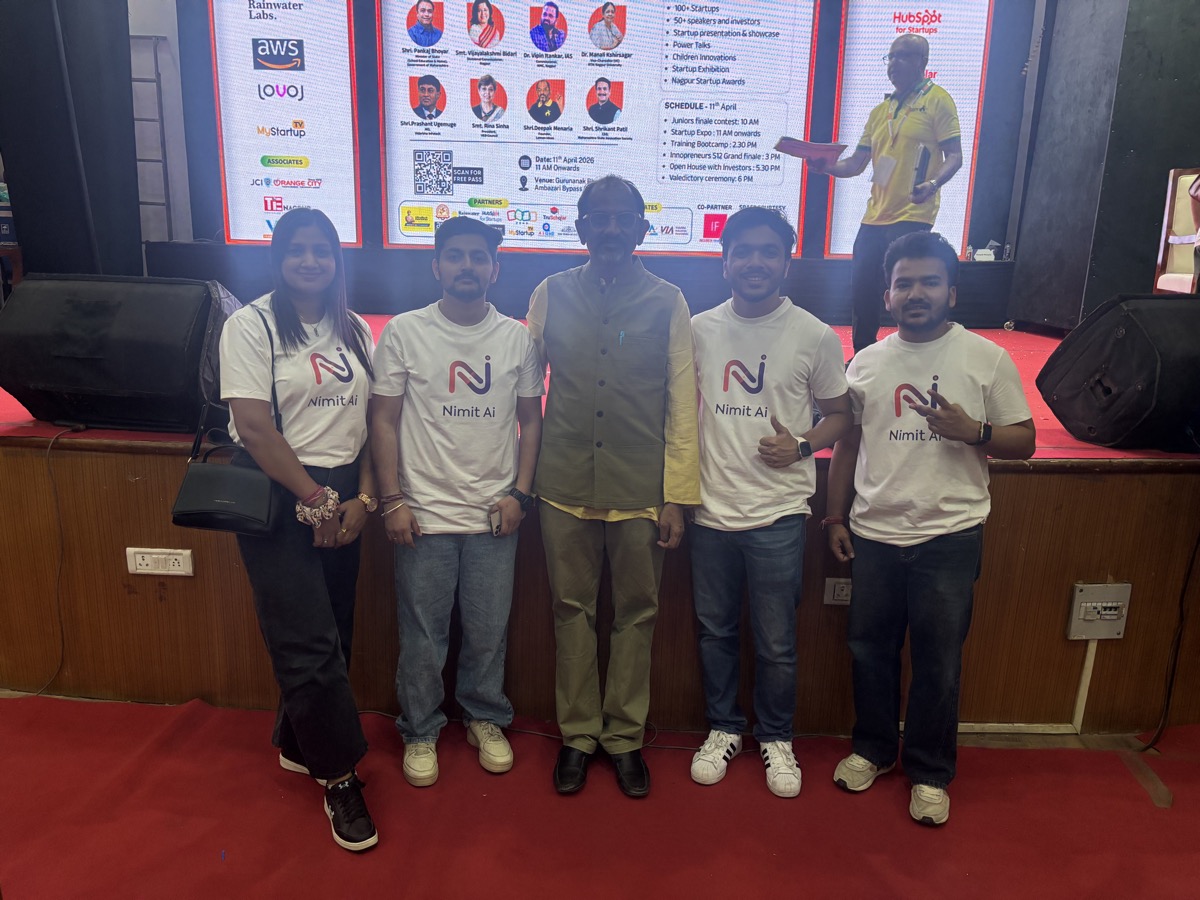
Shubham, Archit, and Nilansh showing Nimitai QR codes on branded t-shirts at the VED Council Viksit Bharat Conclave

Our Nimitai branded t-shirts with QR codes on the back. A small move that started more conversations than our pitch deck.

Beyond the demo itself, branding matters in the corridors too. We wore Nimitai-branded t-shirts with QR codes printed on the back, a small move that started more conversations than our pitch deck. People scanned the code, landed on our site, and came back to ask questions. At events like the Viksit Bharat Conclave, every surface is a demo opportunity.

If your product can run live, run it live. The risk is worth it.

Lesson 2: Your numbers will be challenged, so know them cold

One of the judges, Dr. Vishesh Kasliwal (Founder, Medysense Technologies), drilled into our user metrics and product accuracy with the clinical precision you would expect from a founder who built a healthtech company. He did not accept broad estimates.

"Work on accuracy and improve user numbers." Dr. Vishesh Kasliwal, Founder, Medysense Technologies

The feedback was direct: numbers that are vague or inconsistent across a pitch signal that founders are not close enough to their own product. Investors interpret this as a lack of rigour, which bleeds into how they perceive everything else you say.

What to prepare

Before any pitch, be ready to answer on the spot:

  • How many active users do you have?
  • What is your weekly retention?
  • What is the accuracy of your core model, and how do you measure it?
  • What does success look like for a user in the first 30 days?

If you hesitate on any of these, you are not ready to be challenged on your numbers.

More importantly: if your numbers are not where you want them yet, say so, and explain exactly what you are doing to move them. Honesty about the gap, paired with a clear plan, is far stronger than a defensive deflection.

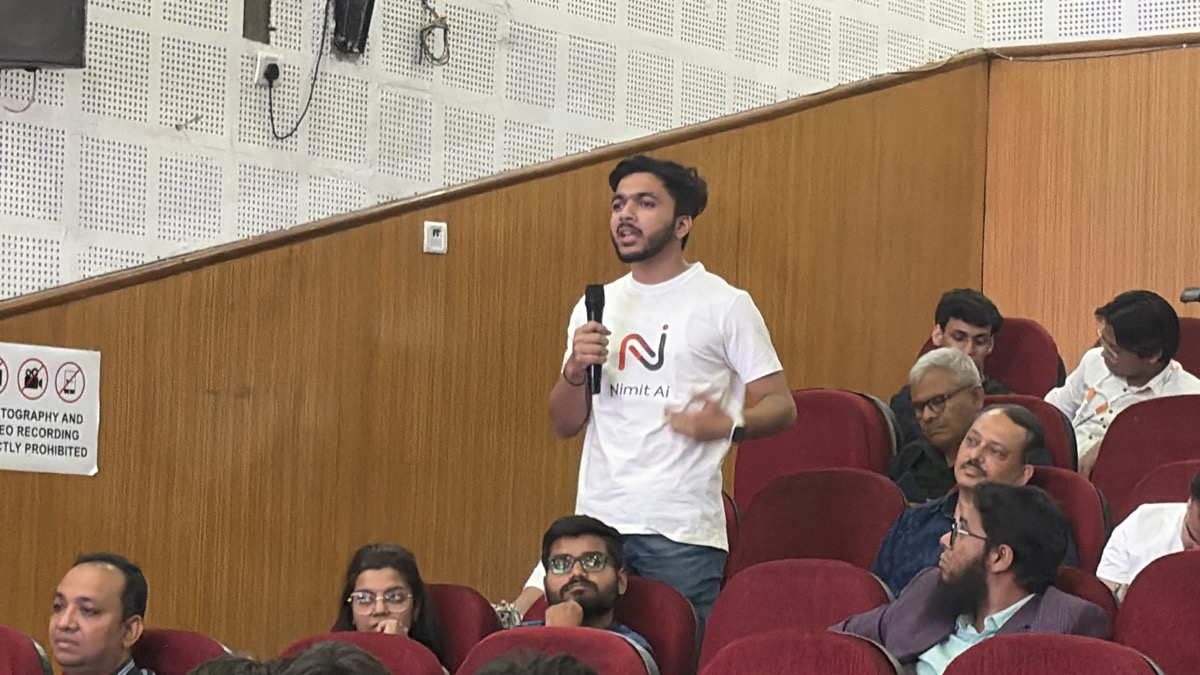
Q&A session with judges at the Innopreneurs Season 12 pitch, with Dr. Vishesh Kasliwal and other judges asking questions

The Q&A with judges. This is where the real evaluation happens, not the slides.

Lesson 3: Pivoting is a strategy, not a failure

Nimitai has iterated on its positioning and product scope several times since we started. When one of the judges asked about our product journey, we were honest about the changes we had made and why.

That honesty resonated with Sagar Bhajani (Co-founder, Khichdiwala), a founder who built a food brand from scratch and understands what iteration under pressure actually looks like.

"Pivot is not the end; it is the next step ahead." Sagar Bhajani, Co-founder, Khichdiwala

The framing matters enormously. A pivot described as "we changed direction because the first idea did not work" sounds like a loss. The same pivot described as "we discovered through real customer conversations that the more urgent problem was X, so we repositioned around that" sounds like exactly what good founders are supposed to do. This is especially true in founder-led sales, where your personal credibility is inseparable from the product narrative.

How to talk about pivots in a pitch

Lead with the learning, not the failure. What did you discover? What customer conversations or data triggered the shift? How is the new direction better aligned with a real, urgent problem? Investors who have built companies know that almost every successful startup looks different at Series A than it did at incorporation. Owning that narrative builds credibility.

Lesson 4: Position around emotional pain, not features

The single most impactful conversation of the entire event was not during the pitch itself. It was a one-hour session after the pitch with Dr. Abhay Deshmukh (Director, Incubation Foundation), one of the most experienced mentors in the room.

He pushed us on something we had been underplaying: the emotional experience of our user. When a sales leader loses a deal and does not understand why, that is not just a functional gap. It is a feeling of helplessness that erodes confidence and compounds over time. We had been talking mostly about the functional solution. He told us to lead with the feeling.

"Focus on emotional needs over just functional needs." Dr. Abhay Deshmukh, Director, Incubation Foundation

This reframed our entire go-to-market approach. The functional case for Nimitai is that it records, transcribes, and analyses sales calls. The emotional case is that sales leaders no longer have to wonder why they lost a deal, or watch a rep repeat the same mistake twice.

The positioning shift

Ask yourself: what does your user feel before they find your product? What is the anxiety, the frustration, the recurring moment of "not again"? That emotional state is your real positioning anchor. Features explain your solution. Emotional pain explains why someone will pay for it.

The products with the highest retention and lowest churn are almost always positioned around a pain that feels personal, not a feature list that can be copied by a competitor in three months. Deepak Menaria and the Lemon Ideas team understood this instinctively. Their mentorship at Innopreneurs pushed every founder to find the emotional core of their pitch.

Nimitai team with Deepak Menaria, founder of Lemon Ideas, at Innopreneurs Season 12 discussing startup positioning

With Deepak Menaria (Lemon Ideas). Conversations outside the pitch room shaped how we think about positioning.

Lesson 5: Do deep research every single day

Building an AI company means operating in a domain that moves fast. New models, new architectures, new benchmarks, new competitors appear weekly. Founders who are not actively tracking the frontier of their space get outpaced quietly.

This was the advice from Akash Kirtane (CTO, Acube AI), one of the most technically sharp people at the event, who engaged with our pitch at a level of depth that most judges do not.

"Stick to it and do deep research daily." Akash Kirtane, CTO, Acube AI

The word "deep" is important. Reading summaries and newsletters is not the same as reading primary sources: actual papers, actual transcripts of customer calls, actual competitor product walkthroughs. The founders who build genuine domain expertise are the ones who end up with the intuition to make good decisions under uncertainty.

How we interpret this at Nimitai

We block time every morning for structured research: reading papers, listening back to our own sales calls (yes, we use Nimitai on our own calls), and tracking what is changing in conversation intelligence and AI agent tooling. This is not optional. It is the baseline for building something that stays relevant.

Bonus: The corridor conversations that matter most

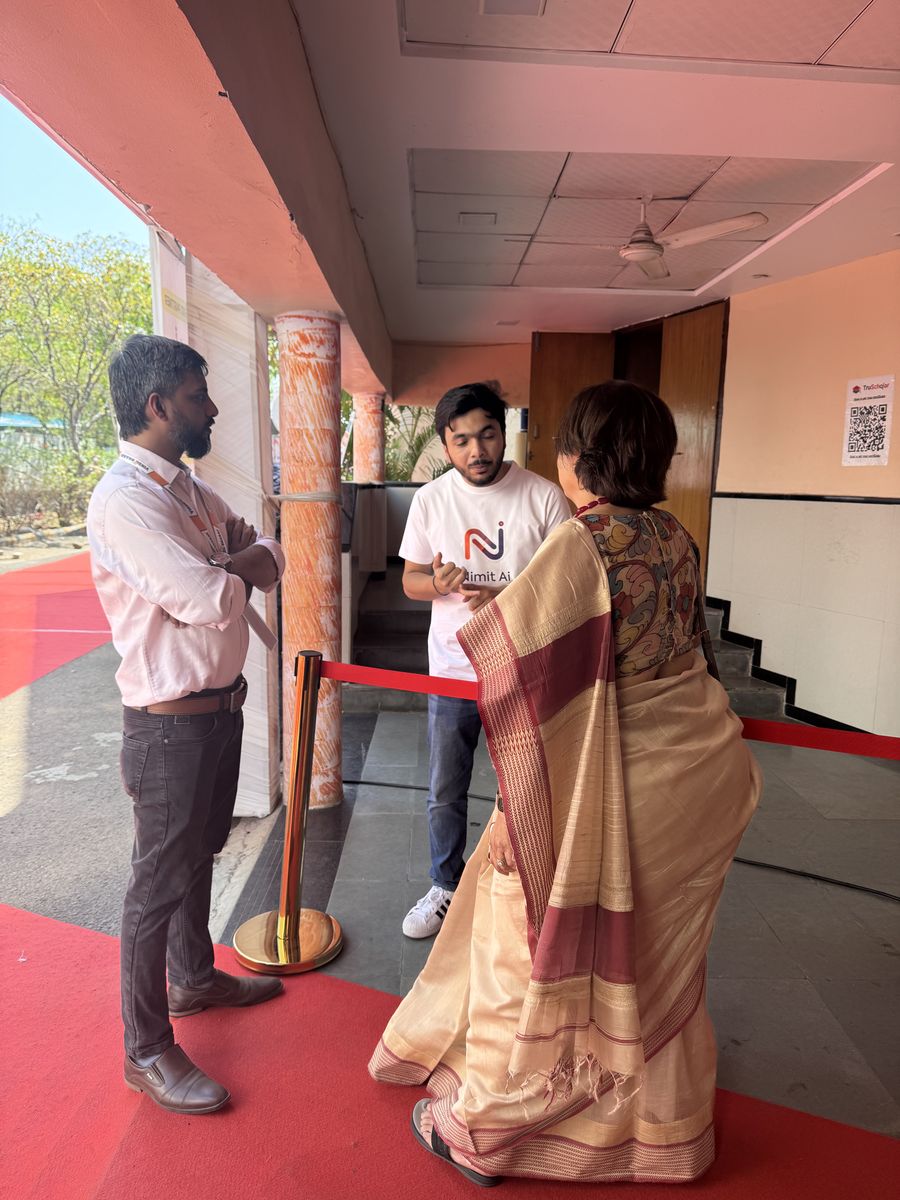
Beyond the formal pitch, some of the most valuable interactions happened in the corridors. Rina Sinha, President of VED Council (Vidarbha Economic Development Council), took genuine interest in Nimitai. She loved the idea and offered to connect us with the broader Vidarbha business ecosystem.

For startups at Innopreneurs, the lesson is clear: the people running the event infrastructure, VED Council and Lemon Ideas, are not just organisers. They are connectors. The startup ecosystem in Nagpur and Vidarbha is growing fast, and events like the Viksit Bharat Conclave are where those connections become tangible.

Networking tip for founders

Do not just pitch to the judges. Talk to the organisers, the sponsors, the other founders backstage. At events hosted at institutions like RTMNU, the ecosystem around the event is often more valuable than the competition itself.

Nilansh Gupta in conversation with Rina Sinha, President of VED Council, at the Innopreneurs Season 12 Viksit Bharat Conclave, Nagpur

Nilansh Gupta in conversation with Rina Sinha, President of VED Council. Networking with event leaders at Innopreneurs Season 12 opened doors beyond the pitch room.

What changed after

Innopreneurs Season 12 was not just a competition. The two days at RTMNU Nagpur compressed months of feedback into a single intense experience. We walked out with five things that changed how we work:

  • Live demos are now the default. We do not use recorded walkthroughs in any meeting where a live demo is feasible.
  • Every team member knows our core metrics. Not just the founders. If any investor asks anyone on the team about user numbers, the answer is consistent and precise.
  • We own our pivot narrative. Our product iterations are documented and framed as learning milestones, not corrections.
  • Our positioning leads with emotional pain. The functional features come after the human problem is established.
  • Research is on the daily schedule. Not aspirational, not "when there is time." Scheduled, protected, non-negotiable.

The judges and mentors at Innopreneurs gave us feedback that was hard to hear in the moment and easy to apply afterward. That is the best kind.

We run every Nimitai demo live, no slides, no recordings. If you want to see what your sales calls look like through Nimitai, book a demo. Nimitai is $149 per seat per month, month-to-month, no seat minimum.

Frequently asked questions

What are the most important tips for pitching to VCs at startup competitions in India?+

The five most consistently cited tips from India-based investors and judges are: (1) Run a live product demo rather than relying only on slides. It demonstrates real capability and generates a different kind of engagement. (2) Know your metrics cold. Investors will probe user numbers, retention, and accuracy; vague answers hurt credibility. (3) Frame pivoting as strategic evolution, not failure. Experienced investors and founders know most startups shift direction; owning that narrative builds trust. (4) Anchor your pitch around the emotional pain your user feels, not just the functional problem you solve. This resonates with investors who think about market size through human behaviour. (5) Do deep, daily research on your domain. Investors can tell the difference between surface-level knowledge and genuine expertise.

Is it better to show a live demo or slides during a startup pitch?+

A live demo is generally more effective than slides alone, provided the product is stable enough to run reliably. Slides communicate intent; a live demo proves capability. At Innopreneurs Season 12, the Nimitai team chose to demo the AI agent live in front of 400+ people and a 5-judge panel. The audience reaction (questions, engagement, follow-up conversations) was noticeably different from what slides alone typically generate. The key risk is a demo failure, which can be mitigated by having a fallback recording and practising the flow thoroughly beforehand.

How should startup founders handle tough questions about user numbers from investors?+

The best approach is to know every metric and the story behind it before walking into a pitch. If your user numbers are small, be honest and proactive: explain the stage you are at, what the numbers mean in context, and what your trajectory looks like. Vague or defensive answers to metrics questions are red flags for investors. Dr. Vishesh Kasliwal (Medysense Technologies), a judge at Innopreneurs Season 12, specifically probed user count and product accuracy, advising: "Work on accuracy and improve user numbers." Acknowledging the gap and stating a clear improvement plan is far stronger than deflecting.

What does "pivot is not the end, it is the next step ahead" mean for startup founders?+

This quote from Sagar Bhajani (Co-founder, Khichdiwala) reflects a mindset shift about product direction changes. A pivot is often perceived as an admission of failure, that the original idea did not work. But experienced founders and investors see it differently: a pivot is evidence of learning, market responsiveness, and founder resilience. Startups that pivot based on real customer feedback are typically further along in their understanding of the problem than those that rigidly stick to their original hypothesis. The key is to pivot with data, not panic.

Why do investors focus on emotional needs rather than product features when evaluating startups?+

Investors think about long-term market behaviour, not short-term feature comparisons. Features can be copied; emotional resonance and identity-level pain cannot. When Dr. Abhay Deshmukh (Incubation Foundation) advised "Focus on emotional needs over just functional needs," he was pointing out that the stickiest products, those that retain users and grow through word-of-mouth, solve a pain that feels personal. For B2B products like Nimitai, that pain is the anxiety a sales leader feels when a deal is lost and they do not know why. Positioning around that feeling creates a much stronger purchasing motivation than listing features.

What does "do deep research every single day" mean as startup advice?+

Akash Kirtane (CTO, Acube AI) used this phrase at Innopreneurs Season 12 to emphasise that consistent domain expertise is a competitive advantage that compounds over time. For AI startups specifically, the field moves fast: architectures, benchmarks, and use cases evolve weekly. Founders who do deep research daily build an intuition that cannot be faked in a pitch or a product meeting. Practically, this means reading primary sources (papers, transcripts, real user interviews) rather than summaries, and building a habit of structured learning into the work schedule rather than treating it as optional.

Tagged:#Innopreneurs#Pitching to VCs#Startup pitch tips#Lemon Ideas#Founder story#Nagpur

Found this insight helpful?

Share with your sales leadership or engineering team.

Share
Nilansh Gupta
Written by

Nilansh Gupta

Founder & CEO at Nimit AI

Building AI meeting intelligence to bridge the gap between sales conversations and closing deals.

Table of Contents
01.Quick answer02.The context03.Lesson 1: Run a live demo, not just slides04.Every surface is a demo opportunity05.Lesson 2: Your numbers will be challenged, so know them cold06.Lesson 3: Pivoting is a strategy, not a failure07.Lesson 4: Position around emotional pain, not features08.Lesson 5: Do deep research every single day09.Bonus: The corridor conversations that matter most10.What changed after11.Frequently asked questions
Nimit Meeting Intelligence

Close more deals on your next call

Catch silent objections in real-time without meeting bots or awkward delays.

Get started free
Keep Reading

Related Articles & Research

Our first flight, our first stage: two Nimitai founders at Innopreneurs Season 12 in Nagpur
Founder Playbook
Apr 17, 2026•8 min read

Innopreneurs Nagpur: Our First Flight and First Stage

Archit and I had never been on a flight before Innopreneurs Season 12. Two days later we were on stage in front of 400 people at RTMNU Nagpur, pitching Nimitai to a panel of VCs and judges.

Shubham Gupta

Shubham Gupta

COO & Co-founder at Nimit AI

Innopreneurs Season 12 by Lemon Ideas: Nimitai named among the Top 10 Innovations of India
Founder Playbook
May 8, 2026•14 min read

Innopreneurs Review: Is It Worth Applying? (Placed 6th)

An honest review of Innopreneurs by Lemon Ideas after competing in Season 12. We placed 6th out of 2,500. Here's what worked, what didn't, and who should apply.

Nilansh Gupta

Nilansh Gupta

Founder & CEO at Nimit AI

Innopreneurs Season 12 winners: the complete Top 10 Innovations of India list, Viksit Bharat Conclave Nagpur 2026
Founder Playbook
May 8, 2026•13 min read

Innopreneurs Season 12 Winners: India's Top 10 (2026)

The definitive list of all 10 winners from 2,500 applicants at Viksit Bharat Conclave Nagpur, April 2026. Names, founders, sectors, judges, and what happened next.

Shubham Gupta

Shubham Gupta

COO & Co-founder at Nimit AI

Nimit AI

The signal behind every close.

AI meeting intelligence for B2B sales teams.

ProductResearcher AgentPreparation AgentMeeting CopilotPricingFree sales tools
CompareNimitai vs GongNimitai vs ChorusNimitai vs FathomNimitai vs FirefliesAll alternatives
ResourcesState of B2B Sales AI 2026Talk ratio studyAI sales meeting prepBlogWhat is Nimit AI?
CompanyAbout the teamNilansh Gupta, CEOPrivacy PolicyEmail: info@nimitai.comCall: +91 99154 94146Sign in
Recognised byTop 10 Innovations of IndiaInnopreneurs Season 12 · Lemon IdeasFeatured startupIdeabaaz Startup Fest
Listed onG24.9 on G211 verified reviewsProduct HuntProduct pageSourceForgeProduct page
Featured on
Featured on LaunchBuffFeatured on LaunchNestVerified on Dang.aiFeatured on LaunchKiwiFeatured on ToolPilot
© 2026 Renai Technologies Private Limited.
Privacy PolicyNimitai — AI Meeting Intelligence